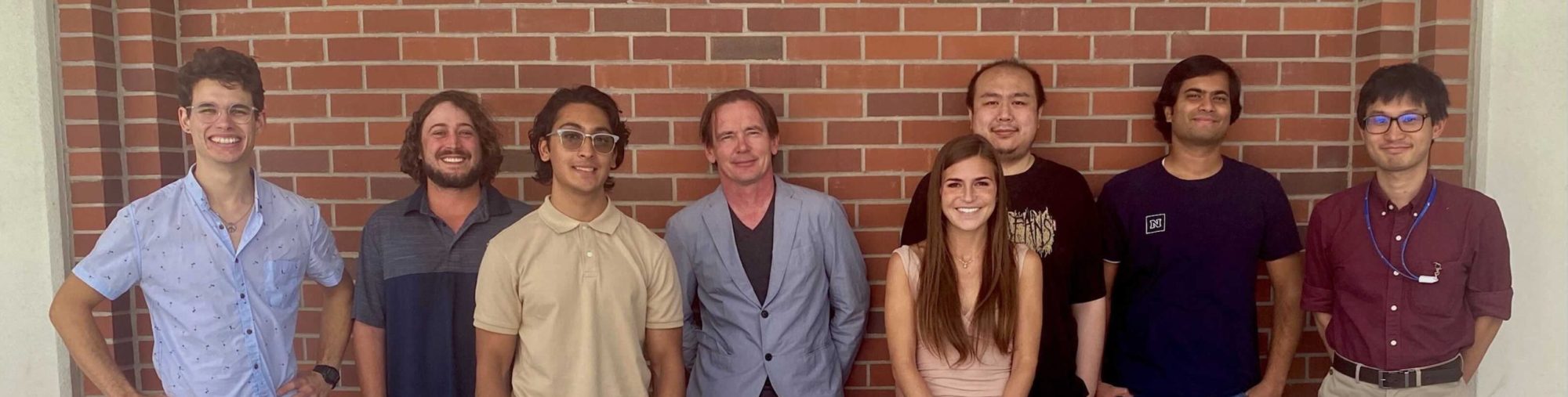
The University of Nevada, Reno, USA invites applications for a full-time Postdoctoral Scholar position with the Department of Physics. The postdoctoral scholar will work in the group of Dr. A. Derevianko. The primary task will be to carry out next-generation calculations of atomic parity violation. Additional topics of interest include dark matter searches and atomic and nuclear clocks. Experience with relativistic atomic many-body theory is desired, but not required. Demonstrated experience in computational physics is required. Anticipated start date is September 1, 2019. Please apply by sending email to Dr. Derevianko ([email protected]).
Author Archives: Andrei Derevianko
Postdoctoral position - ultralight dark matter search [computational/theory/data analysis]
Job Description: The University of Nevada, Reno invites applications for a full-time Postdoctoral Scholar position with the Department of Physics to work with the GPS.DM collaboration. The GPS.DM collaboration carries out a search for ultralight dark matter with GPS constellation atomic clock data.
The postdoctoral associate will be primarily responsible for mining archival GPS data and developing statistical analysis. Website of the collaboration: http://www.dereviankogroup.com/gps-dark-matter/ . Applications received by July 10, 2019 will be given full consideration, but the search will remain open until a suitable applicant is found.
Required Qualifications: Ph.D. in Physics or closely related field by the time of appointment.
Preferred Qualifications: Computational skills and demonstrated experience with statistical analysis.
To apply, please visit:
https://nshe.wd1.myworkdayjobs.com/UNR-external/job/University-of-Nevada-Reno---Main-Campus/Postdoctoral-Scholar_R0116307-1
Required Attachment(s): Attach the following documents to your application.
1) Resume/CV
2) Cover letter
3) You will be required to provide at least two reference letters to be sent by email to Professor Andrei Derevianko at [email protected] .
Contact Information: Professor Andrei Derevianko at [email protected] and Professor Geoffrey Blewitt at [email protected] .
Department Information: For more information about the Department of Physics, please go to https://www.unr.edu/physics .
EEO/AA Women, under-represented groups, individuals with disabilities, and veterans are encouraged to apply.
Faculty position in experimental AMO physics at University of Nevada, Reno
The Physics Department of The University of Nevada, Reno invites applications for a full-time tenure-track position at the rank of assistant professor in the area of experimental atomic, molecular, and optical physics. The successful candidate is expected to be an effective teacher and to establish a vigorous research program; start-up funds will be provided.
The University of Nevada, Reno is the State of Nevada’s land grant and historic flagship institution of higher education and is one of eight institutions of higher education governed by the Nevada System of Higher Education. With a growing and increasingly diverse enrollment of approximately 20,000 students and a total budget of $500 million, the University provides a comprehensive selection of degree programs at the undergraduate, graduate and doctoral level. The university has been recognized as a Tier I institution by US News and World Report. Located in the picturesque Truckee Meadows at the base of the Sierra Nevada, the University of Nevada, Reno is just a short distance from the state capitol, the beautiful Lake Tahoe area, and numerous state and national parks.
Required qualifications: Ph.D. in physics or a related field.
Preferred qualifications: Postdoctoral research experience. Evidence of ability and strong commitment to establish a successful research program in atomic, molecular, and optical physics. Evidence of ability and motivation to teach effectively at the undergraduate and graduate level.
Please apply at https://goo.gl/hYsFb2, and please arrange for two or more letters of reference to be sent to Professor Jonathan Weinstein at [email protected]. Applications and letters of reference should be received by February 20th, 2019. The University of Nevada, Reno recognizes that diversity promotes excellence in education and research. We are an inclusive and engaged community and recognize the added value that students, faculty, and staff from different backgrounds bring to the educational experience.
Dark matter day and the first GPS.DM results
Well, apparently dark matter day is a thing! And perfectly timed to this inaugural event is the publication of our first GPS.DM observatory results. Happy dark matter day!
Search for domain wall dark matter with atomic clocks on board global positioning system satellites
Benjamin M. Roberts,Geoffrey Blewitt, Conner Dailey, Mac Murphy, Maxim Pospelov, Alex Rollings, Jeff Sherman, Wyatt Williams & Andrei Derevianko
Nature Communications 8, Article number: 1195 (2017)
Abstract
Cosmological observations indicate that dark matter makes up 85% of all matter in the universe yet its microscopic composition remains a mystery. Dark matter could arise from ultralight quantum fields that form macroscopic objects. Here we use the global positioning system as a ~ 50,000 km aperture dark matter detector to search for such objects in the form of domain walls. Global positioning system navigation relies on precision timing signals furnished by atomic clocks. As the Earth moves through the galactic dark matter halo, interactions with domain walls could cause a sequence of atomic clock perturbations that propagate through the satellite constellation at galactic velocities ~ 300 km s−1. Mining 16 years of archival data, we find no evidence for domain walls at our current sensitivity level. This improves the limits on certain quadratic scalar couplings of domain wall dark matter to standard model particles by several orders of magnitude.
Comprehensive review on precision measurements with atoms and molecules
Search for New Physics with Atoms and Molecules
M.S. Safronova, D. Budker, D. DeMille, D. F. Jackson Kimball, A. Derevianko, C. W. Clark
This article reviews recent developments in tests of fundamental physics using atoms and molecules, including the subjects of parity violation, searches for permanent electric dipole moments, tests of the CPT theorem and Lorentz symmetry, searches for spatiotemporal variation of fundamental constants, tests of quantum electrodynamics, tests of general relativity and the equivalence principle, searches for dark matter, dark energy and extra forces, and tests of the spin-statistics theorem. Key results are presented in the context of potential new physics and in the broader context of similar investigations in other fields. Ongoing and future experiments of the next decade are discussed.
Full text for this 112 page/24 fig. review is available at arXiv (https://arxiv.org/abs/1710.01833). The paper is currently under review in Reviews of Modern Physics. Comments/corrections are welcome.